
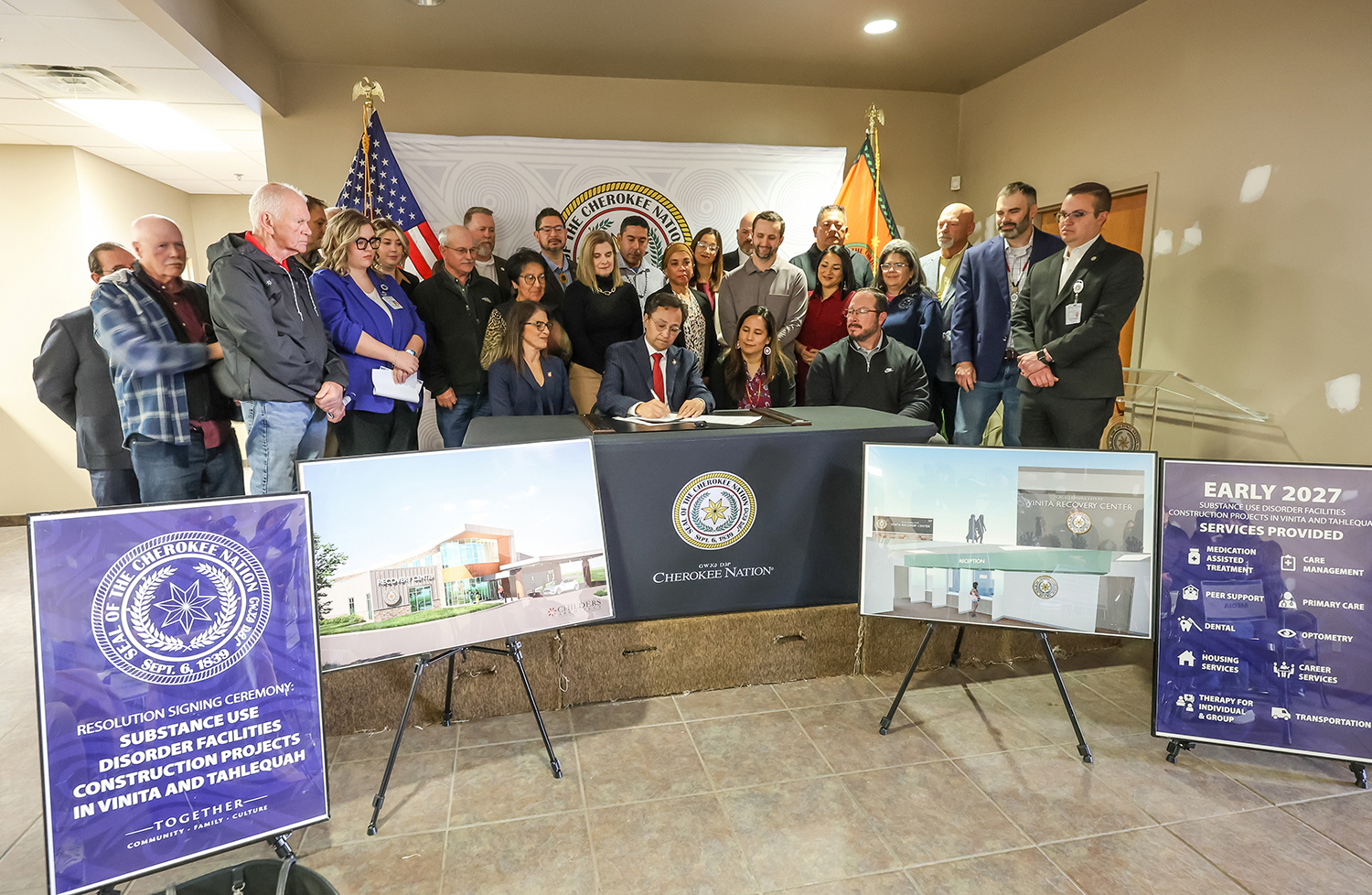
VINITA, Okla. — Cherokee Nation Principal Chief Chuck Hoskin Jr. and Deputy Chief Bryan Warner signed into law new legislation on Jan. 14 investing $23 million for additional substance use disorder treatment and recovery centers within the Cherokee Nation Reservation.
The Council of the Cherokee Nation officially approved Chief Hoskin and Deputy Chief Warner’s legislation on Jan. 12. The new law will add a new outpatient recovery center in Tahlequah and build an additional outpatient recovery center in Vinita.
“In 2022, after our incredible legal team bent opioid companies to a settlement, Deputy Chief Warner, the Council and I pledged to make the industry pay for new substance use disorder treatment facilities,” said Chief Hoskin. “Today we are reaching yet another milestone in our journey of justice.”
In 2022, Chief Hoskin, Deputy Chief Warner and the Council of the Cherokee Nation enacted historic legislation to lock down $100 million in opioid settlement funds to build treatment and recovery facilities.
In 2024, Cherokee Nation broke ground on its first in-patient facility for adults to address substance use disorder and related conditions. The $41 million facility is currently under construction southwest of Tahlequah.
The legislation signed Wednesday designates the Tahlequah site as a campus with an additional $18 million outpatient facility to sit alongside the in-patient facility. The tribe expects to complete both projects by 2027.
“We promised to make the opioid industry pay for the harm it brought our citizens,” said Deputy Chief Bryan Warner. “Today, with the outpouring of support from our Council, we are making progress and using this new legislation to go further.”
The resolution also provides for a new facility in Vinita at a cost of $5 million. Chief Hoskin and Deputy Chief Warner plan to remodel the site of a former Veterans Administration health clinic into an outpatient center for those in recovery. Cherokee Nation acquired the property last year.
The planned Vinita outpatient recovery center, located approximately one mile north of the tribe’s primary care outpatient facility, is expected to open in 2026 to help Cherokee citizens in need.
Councilor Kendra McGeady, of Vinita, praised the plan.
“We understand that addiction affects every family across this reservation, and establishing outpatient clinics like this in Vinita is going to help bridge the gap to access those services, and allow our citizens to thrive,” said McGeady.
Speaker of the Council Johnny Jack Kidwell said the Council will be eager to see the progress and positive impact of the new facilities.
“The Cherokee people expect us to spend opioid settlement dollars wisely,” said Speaker Kidwell. “Across tribal leadership, we are working hard to meet those expectations by building state-of-the-art treatment and recovery facilities, staffing them with expert professionals, and using the best cultural and evidence-based care.”
Chief Hoskin said the expanded Tahlequah campus and new facility in Vinita are some of the many phases needed to fully address the challenge of substance use disorder across the Cherokee Nation Reservation.
“Today’s official signing of this legislation represents the latest chapter, but sadly it cannot be the final chapter, in our effort to bring about healing for those in need of or in recovery,” said Chief Hoskin. “In the years ahead, we will need to operate not only top notch inpatient and outpatient facilities, but also a network of residential transitional recovery centers. Fortunately, we have the funding, capacity and strategies in place to keep moving forward.”
The tribe previously launched millions of dollars in new addiction recovery demonstration programs and created a $5 million endowment to fund scholarships through the Cherokee Nation Foundation for Cherokees pursing behavioral health degrees to generate a pipeline of behavioral health workforce for the centers.
Just a few hours prior to Wednesday’s signing, Cherokee Nation leaders learned that billions of dollars in federal grants nationwide currently assisting with substance use disorder treatment and behavioral health needs are being eliminated by the federal government. This includes $4 million in federal grant funds being cut from the Cherokee Nation. Chief Hoskin said the tribe will fill the gaps caused by the federal grant funds being eliminated.
“It’s well documented that the opioid industry preyed on Cherokee citizens, filling our market with opioids. As a result, the Cherokee Nation has invested millions into construction of treatment facilities. We will not go backward or make cuts, and will do everything possible to fill this unwarranted gap,” Chief Hoskin said.
Cherokee Nation operates the largest health system in Indian Country, available to citizens of every federally recognized tribe, and provides over 3 million patient services per year.