
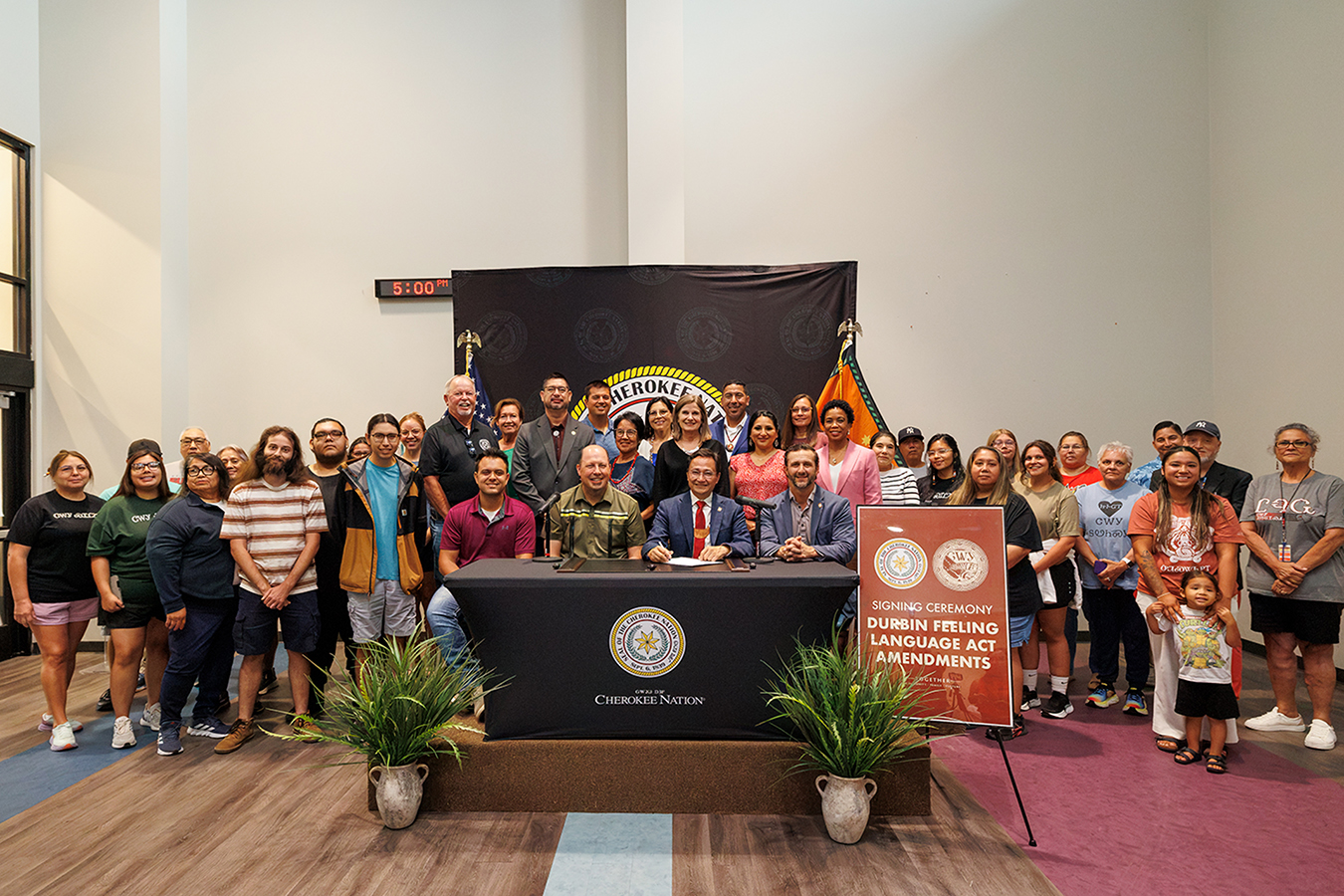
TAHLEQUAH, Okla. — Cherokee Nation Principal Chief Chuck Hoskin Jr. and other Cherokee Nation leaders joined the tribe’s Language department to sign an amended Durbin Feeling Language Preservation Act on Thursday, June 25.
The amendment to this existing law replaces the tribe’s language immersion state charter board with tribal government oversight. Chief Hoskin and Deputy Chief Warner first announced the proposed change earlier this month and the Council of the Cherokee Nation approved the amendment during a special meeting on June 25.
“This amendment declares our independence and affirming that we will preserve, protect and revitalize the Cherokee language to the best of our ability as a sovereign nation,” Chief Hoskin said. “We have had a wonderful relationship with the Oklahoma State Department of Education, but this gives the tribe an opportunity to reach a new excellence in language immersion education for our second-language learners. This is just the beginning to another historic time in the Cherokee Nation.”
The amended law creates a new internal advisory board, the Cherokee Nation Immersion Education Advisory Board, and requires the program to maintain accreditation from a qualified-third party accrediting body. The board will include four appointees subject to Council confirmation and a fifth member selected by the four appointees, serving staggered terms. At least two members will be required to be fluent speakers and at least two will be required to have professional teaching or school administration experience.
The tribe currently has a provisional accreditation with the World Indigenous Languages Higher Education Consortium (WINHEC) which evaluates schools according to standards developed by and for Indigenous communities while it completes full accreditation. Chief Hoskin anticipates engaging WINHEC as the accreditor to meet the third-party oversight requirements of the legislation.
The legislation requires the Principal Chief to generate annual reports on the state of the language immersion program and makes the Principal Chief, the Deputy Chief and Speaker of the Council non-voting ex officio members of the new oversight board.
“These amendments to the Durbin Feeling Language Preservation Act are opening the door to a new chapter for the Cherokee Nation. The tribe has been blessed to have partners like the state of Oklahoma to help us build what our immersion school is now, but dropping the charter title will fully give us the opportunity to be good stewards of our precious language and the immersion school.” Deputy Chief Bryan Warner said.
Cherokee Nation’s language immersion school began in 2001 a pioneering effort led by then Chief Chad Smith. Since 2011 the tribe has operated the school as an Oklahoma public school under the state’s charter school law, receiving state funding and falling under the Oklahoma State Board of Education with state-mandated curriculum and exams.
In late 2023, Chief Hoskin proposed amendments to the Durbin Feeling Language Preservation Act, the landmark 2019 law and the cornerstone of the Hoskin/Warner Administration’s language revitalization efforts. Those amendments, permanently reauthorizing the Act, was approved by the council in January 2024. The amended law called for a special report on the effectiveness of the immersion program and to identify opportunities to end the state charter. The amendments empowered Chief Hoskin to end the charter for curriculum better aligned to Cherokee culture and designed for Cherokee language learners with tribal oversight.
“I’m proud of this update, because I know that our language will not become a whisper,” Cherokee Nation Language Department Executive Director Howard Paden said. “Different tribes throughout the United States have continued to build their language curriculum up as well and they all dream of the day of language sovereignty. Other tribes will follow this path that the Cherokee Nation, the Hoskin/Warner administration and the Council are doing for language.”
Under the Durbin Feeling Language Preservation Act, the tribe since 2019, has invested over $175 million in language preservation efforts. This includes construction of the Durbin Feeling Language Center in Tahlequah and expanding the adult Cherokee Language Master Apprentice Program, both conceived of and piloted during the administration of Chief Hoskin’s predecessor, Chief Bill John Baker.
The language law also expanded immersion education to other communities, established the Speaker Services program to help the remaining population of elder first-language fluent speakers improve their quality of life, funds speaker villages near the language center where Cherokee language and culture are experienced organically in a community setting with affordable housing and community space.
The law sets a budget floor of $18 million in annual operating dollars, but the tribe has increased it annually, funding the department’s current year at $28 million.
The Durbin Feeling Language Preservation Act also funded a new immersion middle school, a state of the art $30 million facility located on the Durbin Feeling Language campus, an area located west of the tribe’s main government complex.
The Durbin Feeling Act established the Language Department as a stand-alone executive director level department expanded staffing, programs and partnerships with third parties in the creative arts and information technology.
“The historic Durbin Feeling Language Preservation Act has made a tremendous impact on our efforts to perpetuate the Cherokee language and ensure its continued growth for future generations. Transitioning away from state charter status and toward a more culturally informed and aware accrediting body will be integral in ensuring students are immersed in Cherokee culture, language and lifeways,” Speaker of the Council Johnny Jack Kidwell said.
The tribe’s current charter expires on June 30, 2026. After will be a period of transition of the current state charter school board into the new internal oversight body.
Tribal officials say that the state funding provided by the charter will be replaced by other funds within the tribe’s budget.
“Supporting the Durbin Feeling Language Act is an investment in our identity, our culture, and our future. It sends a clear message that the Cherokee language is not a relic of the past, it is a living language that belongs in our schools, our communities, our government and our daily lives,” District 8 Councilor Codey Poindexter said.
Cherokee Nation’s Immersion School in Tahlequah has 142 students, with 12 participants in the tribe’s new baby immersion classroom.
The baby immersion through eighth grade immersion school, named ᏧᎾᏕᎶᏆᏍᏗ (tsunadeloquasdi), is located in the Durbin Feeling Language Center, located west of the tribe’s main complex in Tahlequah.
Opening in the fall is the tribe’s new immersion middle school, which will relocate fourth through eighth grade students, and is named ᏧᎾᏕᎶᏆᏍᏗ ᎦᎵᏉᎩ ᏂᏚᏳᎪᏛ Tsunadeloquasdi Galiquogi Niduyugodv “School of the Seven Directions” located west of the Durbin Feeling Language Center in Tahlequah.
A Cherokee Immersion school in the Greasy community of Adair County also has 12 students and another 12 in its baby immersion classroom.