
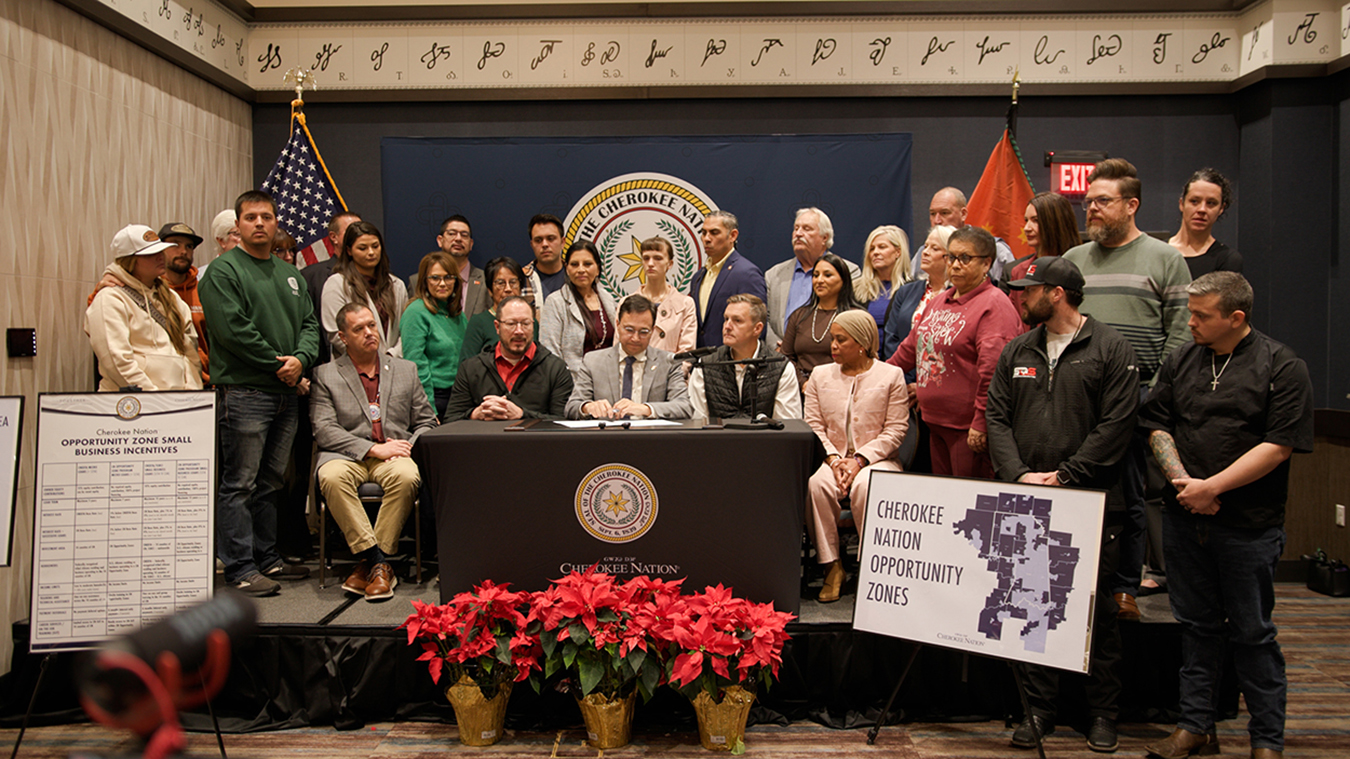
TAHLEQUAH, Okla. – Cherokee Nation Principal Chief Chuck Hoskin Jr. and Deputy Chief Bryan Warner formalized a plan on Dec. 19 to steer more of the tribe’s small business support resources to underdeveloped areas of the Cherokee Nation reservation.
Chief Hoskin first announced the concept of “opportunity zones” at his State of the Nation address on August 30 in Tahlequah, and shared more aspects of the idea at the tribe’s annual Native owned small business banquet on Nov. 20 in Catoosa.
Friday’s announcement formalizes “Cherokee Nation Opportunity Zones” through Chief Hoskin’s executive order.
“Our Cherokee Nation Opportunity Zone plan takes existing small business support programs and services, including micro-loans and special federal matching funds and targets them like a laser at parts of the Cherokee Nation where private investment is lacking and poverty is high,” said Chief Hoskin. “The Opportunity Zones plan is now an additional tool among many that we can use to lift up Cherokee Nation communities that struggle the most.”
Friday’s order designates over 180 U.S. Census Bureau tracts within the Cherokee Nation Reservation and in counties contiguous to the reservation with relatively high poverty levels as measured by the United States Department of Agriculture as “Cherokee Nation Opportunity Zones.” The designated tracts have poverty rates of at least 19% accordingly to the U.S. Census or are in counties designated “persistently high poverty counties” by USDA.
The plan primarily utilizes two of the tribe’s small business capital programs, Cherokee Nation Economic Development Trust Authority, and the State Small Business Credit Initiative, to target resources to the designated Opportunity Zones.
CNEDTA is a business lending program affiliated with the tribe, operating a federally qualified Community Development Financial Institutions Fund (CDFI). SSBCI is a federal backed fund which provides dollar for dollar matching of qualified small business loans. Cherokee Nation’s SSBCI is valued at around $84 million over through 2034.
CNEDTA, established in 1989, makes business loans across the Cherokee Nation reservation annually. CNEDTA makes policy and lending decisions independently through its board. Cherokee Nation began its SSBCI program in 2024 and operates nationwide.
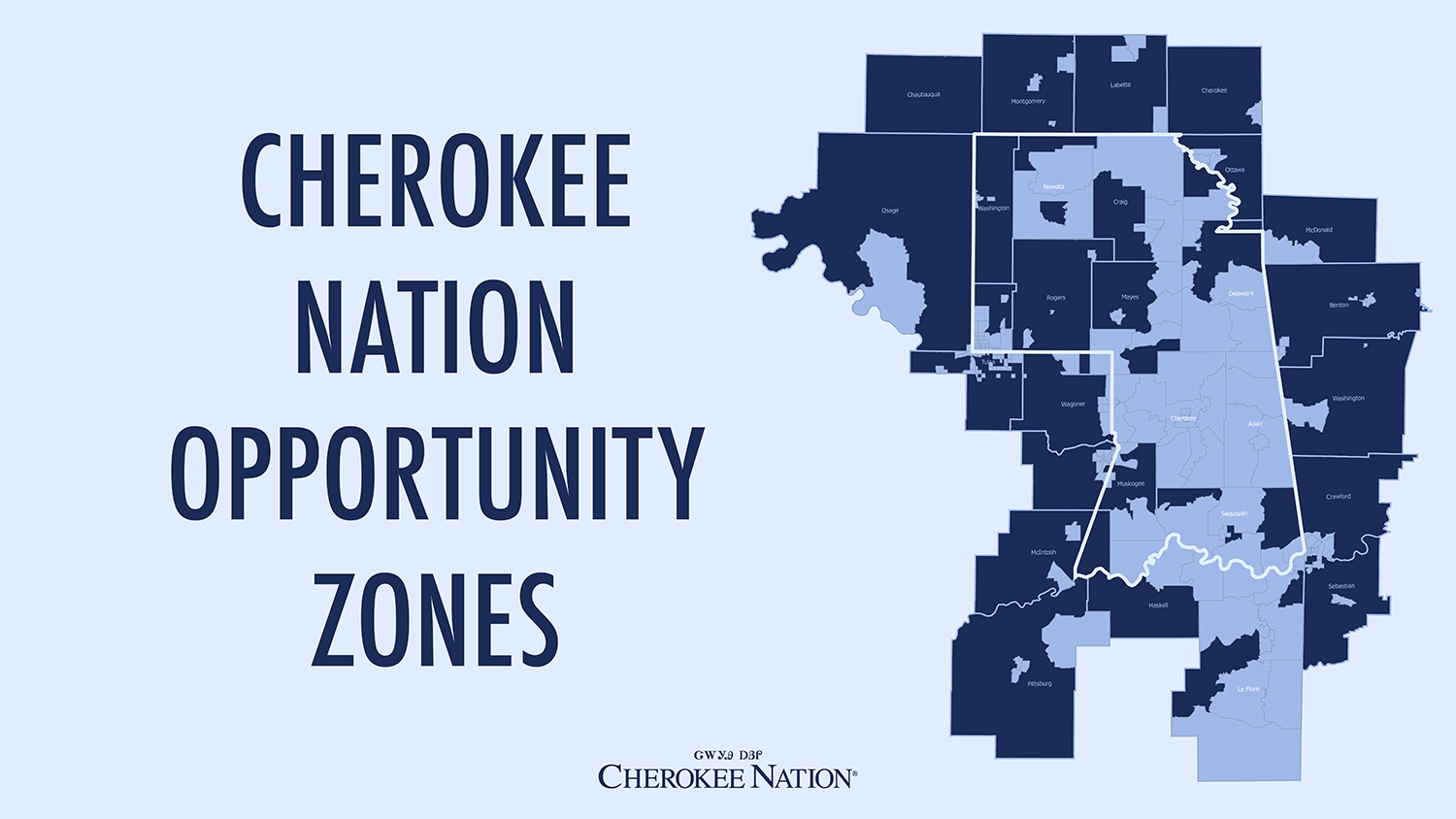
The Opportunity Zone plan increases lending caps for micro-loans, lowers interest rates and makes SSBCI funds available to non-citizens who invest in the zones. Small businesses participating in the program may also be eligible for additional workforce development resources, such as the tribe’s on the job training programs.
“Under this plan we are keeping our commitment to not only every square inch of the Cherokee Nation Reservation, but to every at-large citizen,” said Deputy Chief Warner. “But, the new Opportunity Zone plan acknowledges that when we find communities struggling economically, we need to extend an extra measure of support.”
Over a dozen Cherokee Nation citizen entrepreneurs joined Chief Hoskin, Deputy Chief Warner, cabinet members and Council members at Friday’s announcement at the tribe’s Chota Center in Tahlequah.
“My parents started our small business nearly 30 years ago, without it I wouldn’t be who I am,” said Springwater Outdoor Solutions owner Dillin Springwater. “We do many things from cutting grass to cleaning windows and building decks. During a hard year back in the 2000s my parents won a contract from the tribe that really carried us through a hard year. We’ve taken advantage of the SSBCI loan program and it’s helped our business immensely. We were also one of the first TERO certified businesses.”
Cherokee Council Speaker Johnny Jack Kidwell praised the plan, as another way to enhance and strengthen communities by supporting and encouraging entrepreneurs.
Palmer Construction President Kayla Palmer attended the signing ceremony.
“Small businesses face a lot of challenges, especially construction as many banks won’t offer loans to construction companies,” said Palmer. “The opportunity that the tribe is offering now is immense. I’ve utilized the SSBCI program which pairs you with a business coach. I learned so much from how to utilize a CPA and compete for small business contracts.”
The plan also authorizes special “Opportunity Zone Public Investment Projects,” infrastructure to support third party partners.
Two such pilot projects are planned for the tribe’s industrial park near the Adair County communities of Cherry Tree and Stilwell as well as a project in the Sequoyah County community of Marble City.
At the tribe’s industrial park, the tribe plans construction of a facility to house a modular home manufacturing facility as well as a building trades program an office to promote business development in the park.
At Marble City the tribe plans to construct a facility that combines a warehouse for further community development in the region as well as a retail convenience store operated by a third-party lessor.
Both projects utilize a portion of CNEDTA and SSBCI resources to be loaned to Cherokee Affordable Housing, an existing non-profit closely affiliated with the tribe’s housing authority.
To fully implement the plan, CNEDTA will need to consider and approve some lending policy changes at the Council of the Cherokee Nation will need to add between $5.5 million and $7 million to CNEDTA pool of lending. Chief Hoskin anticipates consideration of these policy changes and budgets before the end of January.
“The Council looks forward to examining the potential of this new program,” said Council Speaker Johnny Jack Kidwell. “We’re guiding its budget toward our shared goals of boosting the tribe’s economy and supporting its business owners.”
Under Chief Hoskin’s executive order, the new program will be overseen by Secretary of State Shella Bowlin, Executive Director of Commerce Anna Knight and Chief Hoskin’s Senior Advisor and Executive Director of Housing Programs, Todd Enlow.
“Opportunity Zones, whether through our unique projects at Cherry Tree and Marble City or a new business start-up in another rural low-income community can be a vital part of our overall effort to revitalize Cherokee communities,” said Enlow.
The tribe’s CNEDTA has loaned over $35 million to small businesses since 2010. Since 2024 the tribe’s Commerce Services have provided over $7.5 million in loans through its SSBCI matching loan program.