
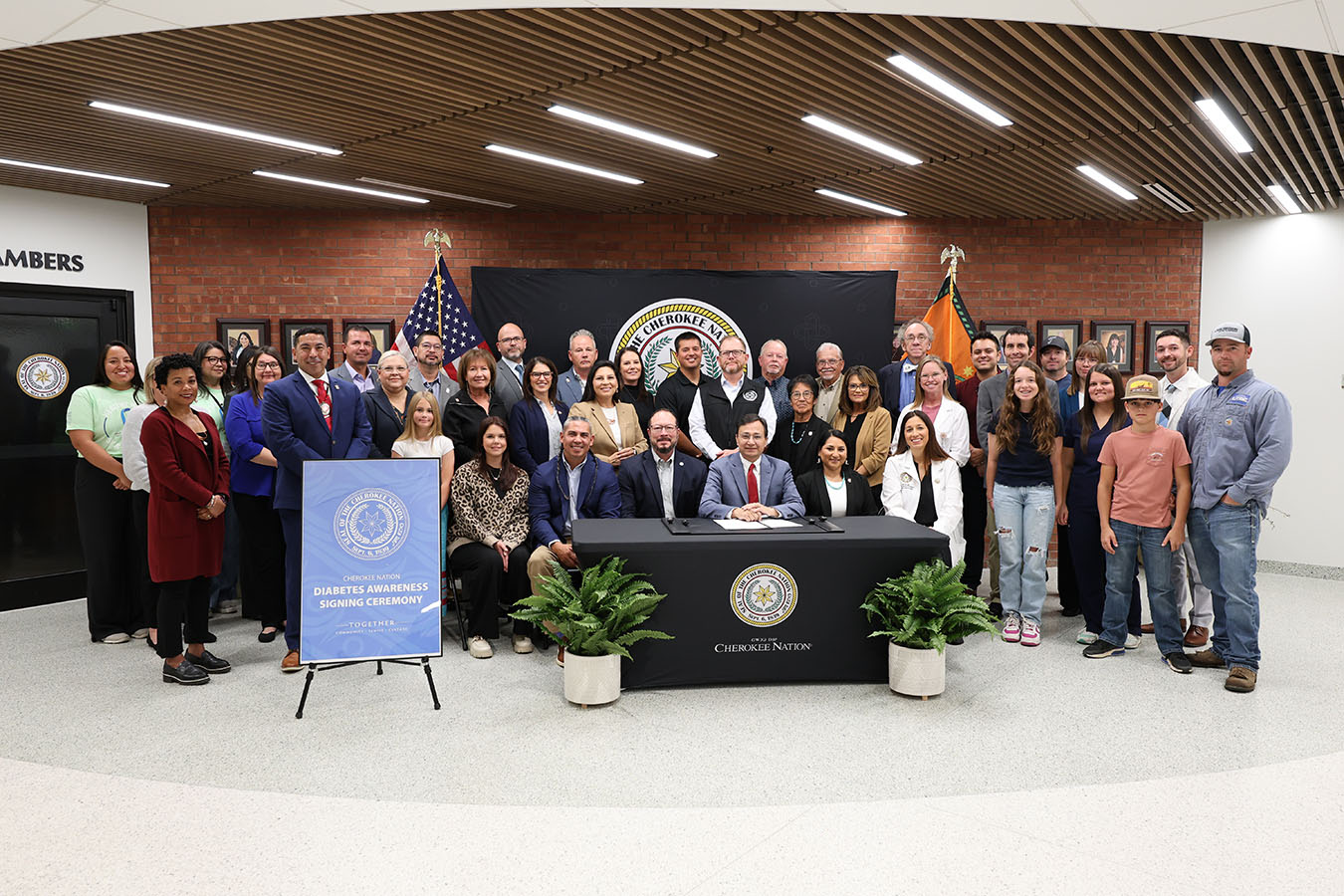
TAHLEQUAH, Okla. — In recognition of Diabetes Awareness Month in the Cherokee Nation, Principal Chief Chuck Hoskin Jr. signed an administration memorandum Monday establishing the Pediatric Automated Insulin Delivery Device initiative, which will expand access to advanced diabetes management technology for Cherokee children living with Type 1 diabetes.
The signing ceremony took place inside the W.W. Keeler Tribal Complex in Tahlequah, with tribal leaders, Cherokee Nation Health Services and Public Health staff and families of pediatric patients in attendance.
The memorandum directs the Cherokee Nation chief of staff and Cherokee Nation Health Services to establish a comprehensive program providing automated insulin delivery systems that integrate with continuous glucose monitoring technology and automatically adjust insulin. Cherokee Nation Health Services has identified the Omnipod 5, a tubeless, waterproof device that works with a compatible glucose sensor to continuously monitor glucose levels and deliver insulin day and night.
“Managing Type 1 diabetes is a full-time job for a child and their family, and it shouldn’t stand in the way of a kid being a kid,” Principal Chief Chuck Hoskin Jr. said. “Our healthcare system has grown to the point where we can put the latest technology in the hands of the families who need it most. This initiative is about giving Cherokee children more freedom at school, on the ballfield and at home, while giving parents greater peace of mind.”
Cherokee Nation Health Services currently serves an estimated 95 pediatric patients and 650 adult patients diagnosed with Type 1 diabetes, an autoimmune disorder with no known prevention or cure. Children with the disease must rely on regular blood sugar checks and insulin delivered by injection or pump, a routine that can be difficult to maintain during long school days and physical activity away from home. Automated devices can allow for remote monitoring and less obtrusive insulin delivery compared to manual testing and injections.
“Families shouldn’t have to choose between what they can afford and what’s best for their child’s health,” Deputy Principal Chief Bryan Warner said. “By removing that barrier, we’re helping our kids stay healthier today and reducing the risk of serious complications down the road. That’s an investment in the future of the Cherokee Nation.”
Cherokee Nation Health Services reviewed the issue during fiscal year 2026 before identifying the program as a priority. The initiative aims to improve long-term glycemic control, enhance quality of life and reduce diabetes-related complications among pediatric patients.
“This is one initiative that I set out to work on when I took my oath on Council. I appreciate Chief Hoskin for making efforts in allowing me the opportunity to voice the concerns of the citizens,” said District 4 Councilor Uriah Grass. “I’d like to add a big wado again to Chief Hoskin, the healthcare team and all that had a hand in making this initiative a reality. This effort is going to truly change the lives of pediatric patients diagnosed with Type 1 diabetes. For those families impacted by this, I know it means so much to them”
Attending the signing were 10-year-old Hazel Branham, who has Type 1 diabetes, along with her mother, Lindsey Branham, and grandmother, Rhonda Merrill. The family met with Chief Hoskin to share their experience and advocate for the tribe’s support for children battling the autoimmune disorder.
“We want to say thank you to the Cherokee Nation, Chief Hoskin, and everybody who worked on this initiative,” said Merrill. “These are 95 children whose lives will be changed for the better. They’re giving them back their lives and their independence — all through this insulin delivery device.”
The new pediatric Diabetes Type 1 initiative will be funded by an annual investment of tribal funds of over $665,000.
The memorandum took effect upon signing on Monday.