
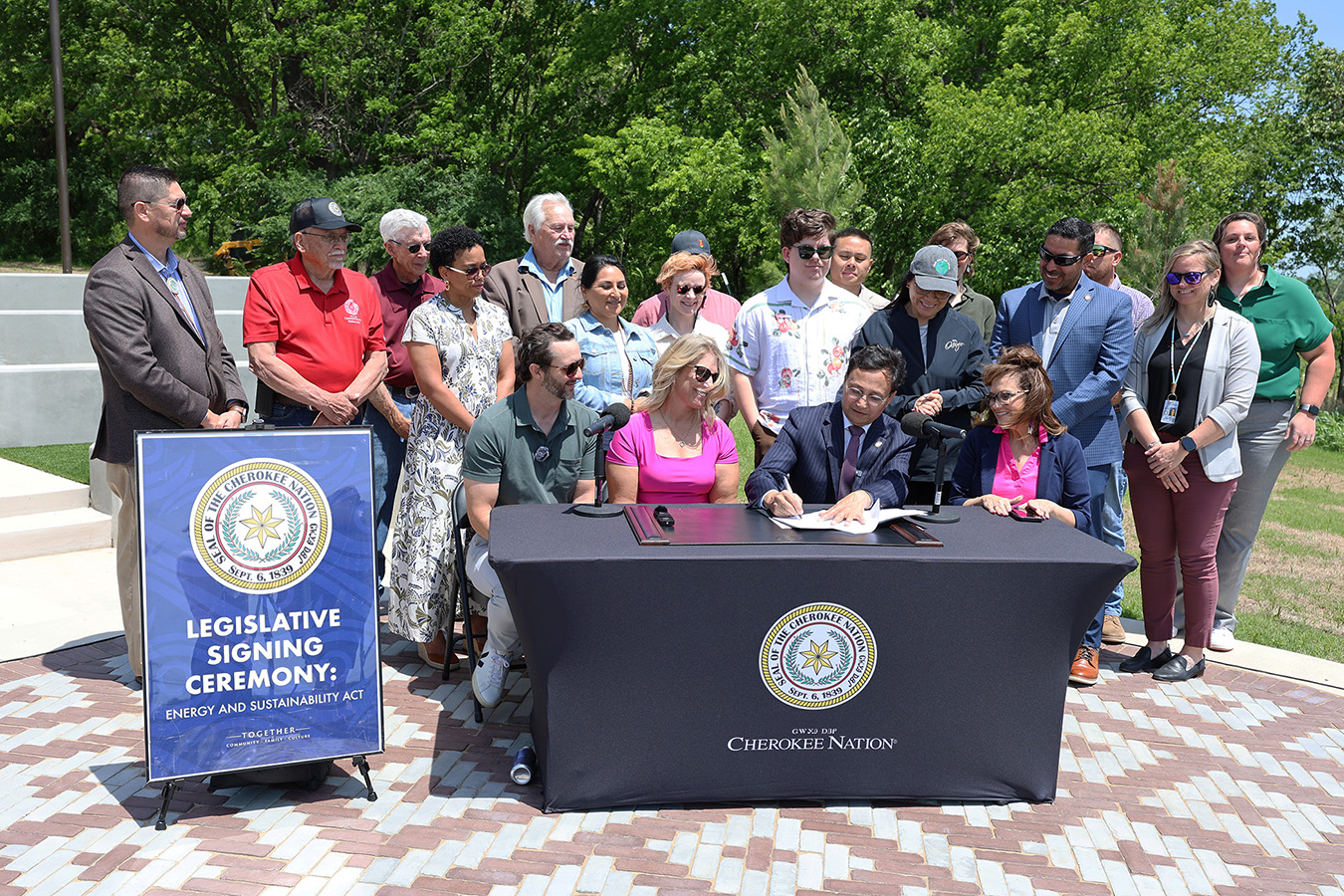
TAHLEQUAH, Okla. — Cherokee Nation Principal Chief Chuck Hoskin Jr. signed the Cherokee Nation Energy and Sustainability Act into law Monday during a ceremony in Tahlequah, marking a significant milestone in the tribe’s commitment to environmental stewardship and conservation.
The new law puts Secretary of Natural Resources Christina Justice primarily in charge of setting goals and formulating policies for a range of sustainability measures, including reducing energy consumption, reducing water usage and increasing recycling across the tribe’s government operations and affiliated entities. Secretary Justice will also oversee a new Office of Energy Programs and serve as the clearinghouse for all major energy and conservation initiatives across Cherokee Nation and its affiliated entities.
“Today we are making a promise to every Cherokee citizen, every child and every generation that has yet to come,” said Chief Hoskin. “The Cherokee Nation Energy and Sustainability Act is not just a law. It is a declaration that we take seriously our role as caretakers of this land. Our people have lived in relationship with the natural world since time immemorial, and this legislation ensures that relationship remains strong and intentional for all the years ahead.”
Major provisions of the Cherokee Nation Energy and Sustainability Act include:
- Centralizes energy policies and initiatives through the Secretary of Natural Resources.
- Establishes an Office of Energy Programs under the tribe’s SONR.
- Requires the SONR to establish recycling, energy efficiency and natural resource conservation goals through three-year plans beginning in fiscal year 2027.
- Requires a net reduction in energy, water consumption and food waste every three years, beginning in fiscal year 2027.
- Establishes a policy of light pollution reduction.
- Authorizes the “Cherokee Nation Recycles” program.
- Authorizes the “Litter Free Cherokee Nation” program.
- Declares efforts at energy efficiency, recycling, litter mitigation, light pollution, natural resource conservation and mitigation of the impact of human-caused climate change as public health issues under Cherokee law.
Deputy Chief Bryan Warner, who proposed the measure alongside Chief Hoskin, said the signing reflects a shared responsibility that extends beyond government.
“Sustainability is not a burden. It is a gift we give to ourselves and to those who follow us,” said Deputy Chief Warner. “This law gives us the tools and the structure to be more thoughtful about how we consume resources, how we manage our land and how we leave this world better than we found it. I am proud that Cherokee Nation is leading by example.”
The Cherokee Nation Energy and Sustainability Act is the second major piece of environmental legislation under the Hoskin/Warner administration. In 2021, the tribe enacted the “Cherokee Nation Park, Wildlands, Fishing and Hunting Preserve Act,” which protects current and future public lands within the Cherokee Nation Reservation. Chief Hoskin has also issued several executive orders reducing single-use plastics, establishing a youth climate change task force and creating the Clean Energy Task Force.
The Energy and Sustainability Act of 2026 passed with a full vote of the Council of the Cherokee Nation.
“This law strengthens our commitment to protecting our natural resources and improving energy efficiency across our communities,” said Councilor Lisa Hall. “I want to thank Chief Hoskin, Deputy Chief Bryan Warner, and Secretary Justice and her staff. I am proud that we are already seeing results – from more than 3,000 trees distributed, to creek cleanups, to solar projects like the one recently at Brushy Community Center that will reduce energy costs. These efforts reflect what this Act is about: protecting our environment and building stronger healthier communities for generations to come.”
For more information about the tribe’s Secretary of Natural Resources office, visit https://naturalresources.cherokee.org/.