

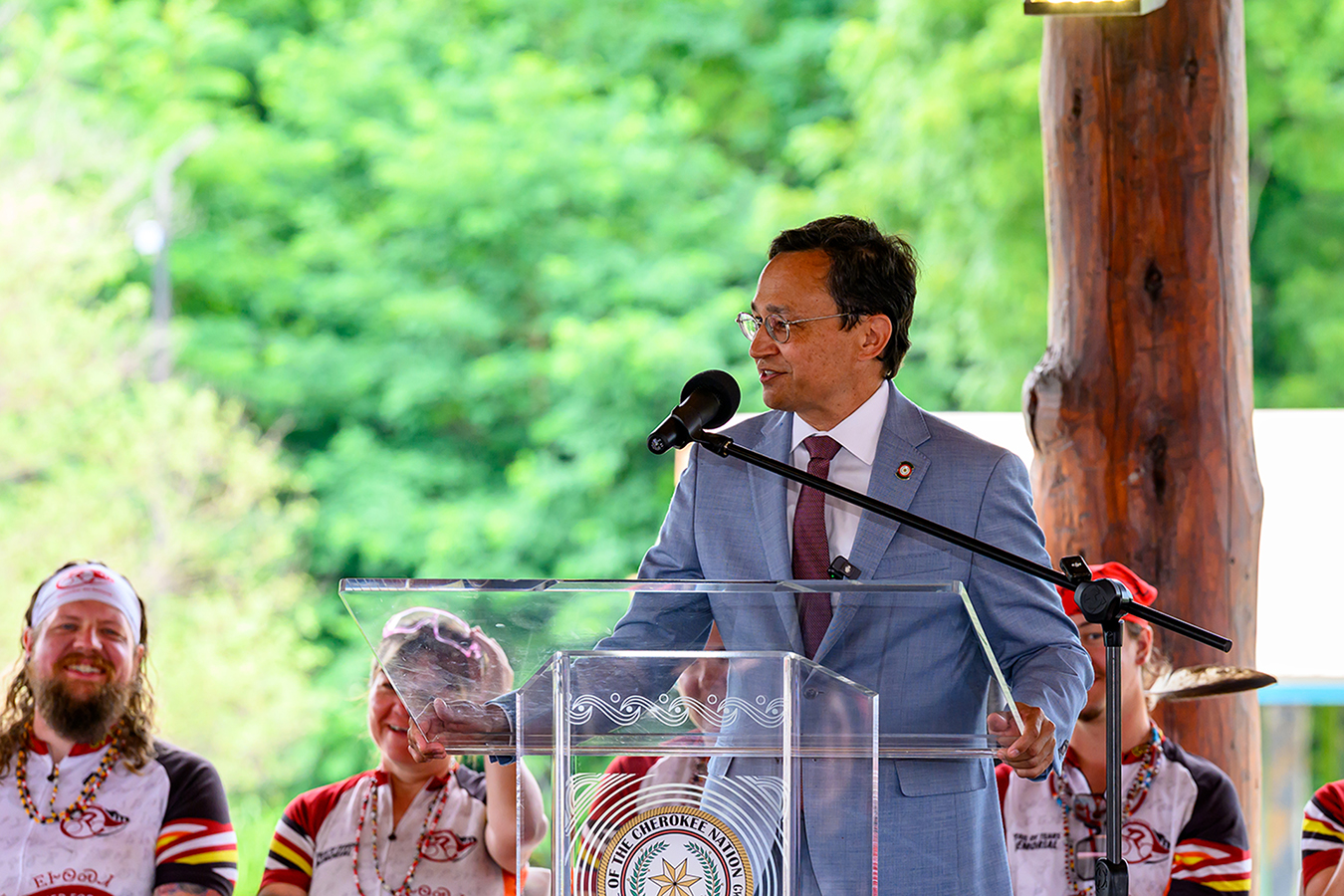
TAHLEQUAH, Okla. — Twelve Cherokee Nation cyclists who were part of the 2026 Remember the Removal Bike Ride and six additional cyclists from the Eastern Band of Cherokee Indians finished their 950-mile journey with a homecoming ceremony in the capital city of the Cherokee Nation.
During their journey, the cyclists retraced the northern route of the Trail of Tears in honor of their ancestors who were forcefully removed from their homelands in the southeastern United States nearly 190 years ago.
“The Remember the Removal Bike Ride provides an incredible avenue for the next generation of Cherokees to learn where they came from,” said Cherokee Nation Principal Chief Chuck Hoskin Jr. “The cyclists saw firsthand the effects of Federal Indian Policy in the 19th century from the United States. The journey allows us to reflect, remember, and to pay tribute to those who came before us, but also to remind all Cherokees of the resiliency our people possess.”
The memorial ride began in New Echota, Georgia, in early June and continued through Tennessee, Kentucky, Illinois, Missouri, Arkansas and Oklahoma before being welcomed back at the Cherokee National Peace Pavilion in downtown Tahlequah.
Training through rain or shine, hills and valleys, for 25 weeks, the cyclists rode nearly 1,500 miles in preparation for the ride. The team also trained to pedal up to 70 miles in a single day.

“We know this journey is heavy and weighs on the hearts of our riders, but it’s a righteous cause,” said Cherokee Nation Deputy Principal Chief Bryan Warner. “All of the departments and staff involved are here in support of this cause, for us to remember. It takes a big heart to process seeing these historic, but tragic, sites.”
Every year, the cyclists reach the boundary of Cherokee traditional homelands, on the banks of the Tennessee and Hiwassee rivers, to visit Blythe Ferry, a historic site where nine detachments passed through the area and crossed the Tennessee River by ferry. During a ceremony with the cyclists and Tennessee state legislators, the Tennessee State Parks upgraded the county park, formerly known as the Cherokee Removal Memorial Park, to state park status and renamed it Cherokee Trail of Tears State Park.
“Although the journey is now complete, the experiences and the memories made during the Remember the Removal Bike Ride will never fade for these Cherokee men and women,” said Deputy Speaker of the Council Kevin Easley Jr. “The Council is proud of each cyclist for committing to this journey and bringing attention to not only our history, but to the strength and endurance we’ve had in the centuries since that time to continue building a stronger Cherokee Nation.”
Taylor Pearce, of Leach, Oklahoma, is the granddaughter of Geri Glass Pearce, who staffed the inaugural 1984 ride. Pearce has a close connection to the program with it being a family affair.
“Since the first pedal stroke of this journey, I have felt the sorrow of remembering the forced removal of my ancestors, the joy of laughter being surrounded by my teammates, the exhaustion of continuing to ride every day and so many more emotions. And still I know that I have experienced the smallest fraction of what those who walked this path before me went through. I’ve always known that everything I have is the result of my ancestor’s strength and resilience, but I had no idea of the true meaning of that statement until this bike ride,” Pearce said. “Walking in the literal footsteps of the ancestors and the bike riders that came before me has given me the strength to continue on when the ride has pushed me to my limits. As I finish my time as an RTR rider, I feel a deeper responsibility to give back to the communities that have supported me, continue to learn about Cherokee culture in order to pass the knowledge on to my children, and to never forget all the Cherokee people have overcome and how we continue to grow and thrive as one people.”
This year marks the 42-year anniversary of the inaugural 1984 ride, when 19 young Cherokees and support staff made the journey in five weeks and nearly 1,200 miles, the path was chosen with interstate maps and historic information from the northern route of the Trail of Tears. The tribe produced a documentary sharing the 1984 riders’ experience in honor of the 40-year anniversary in 2024.
“To represent the Cherokee Nation and honor the resilience of our ancestors is a privilege,” cyclist Kristen Mankiller said. “The physical and emotional weight of this journey is heavy, but it has fueled my commitment to stewardship. We must all ensure the sacrifices that were made are never forgotten.”
Cherokee Nation cyclists include:
- Adrian Gaches, 20, of Stilwell, Okla.
- Adrienne Keene, 40, of Tulsa, Okla.
- Ashley Adair, 24, of Wagoner, Okla.
- Christina Justice, 50, of Tahlequah, Okla.
- Colton Brinsfield, 23, of Checotah, Okla.
- Dugan Gibson, 21, of Talala, Okla.
- Ella Mounce, 22, of Stilwell, Okla.
- Jaden Carrol, 24, of Tahlequah, Okla.
- Jaycee Gideon, 20, of Stilwell, Okla.
- Kristen Mankiller, 43, of Tahlequah, Okla.
- Taylor Pearce, 24, of Leach, Okla.
- Savanah Slayton, 22, of Oklahoma City, Okla.
Eastern Band of Cherokee Indian cyclists include:
- Ernest Pheasant, 17, of Painttown community, Cherokee, N.C.
- Kamiyo Lanning, 46, of Wolfetown community, Cherokee, N.C.
- Jean Arlenea Chapa, 44, of Wolfetown community, Cherokee, N.C.
- Olivia Meli Jackson, 24, of Wolfetown community, Cherokee, N.C.
- Rachel Bruneel, 27, of Yellowhill community, Cherokee, N.C.
- Steven Michael Smith, 32, of Birdtown community, Cherokee, N.C.
The cyclists were greeted by hundreds of friends and family from the Cherokee Nation and Eastern Band of Cherokee Indians upon their return to Tahlequah Friday.
“Participating in Remember the Removal gave me a deeper understanding of the strength and resilience of our Cherokee ancestors. Every mile reminded me that the Trail of Tears is not just history but it’s a story that continues to shape who we are today. Riding alongside fellow Cherokee youth strengthened my connection to my culture and showed me the importance of carrying our history forward for future generations,” cyclist Ashley Adair said.
Of the estimated 16,000 Cherokees forced to march to Indian Territory in the late 1830s, about 4,000 died due to exposure, starvation and disease, giving credence to the name Trail of Tears.